
Yes, you can crosslist eBay inventory to Poshmark profitably — but only if the workflow is platform-aware, the copy is rewritten (not copy-pasted), and inventory sync runs automatically. A repeatable, AI-assisted Poshmark crosslisting strategy cuts per-listing time dramatically while protecting you from double-sells. Resellers listing on multiple platforms report a significantly higher sell-through rate than single-platform sellers. That number assumes quality listings, not duplicated eBay text dropped into Poshmark.
Before you scale, check these three go/no-go signals:
- Item type: Fashion, accessories, and branded apparel convert well on Poshmark. Electronics, parts, and industrial items do not.
- Price band: Items priced above $15 face Poshmark’s 20% fee. Build that into your margin math before listing.
- Inventory volume: Manual delist protocols work under roughly 30 live listings. Above that, auto-delist tools are worth every penny of the subscription.
Table of Contents
- What does a complete Poshmark crosslisting strategy look like end-to-end?
- How to build one master listing and turn it into a Poshmark post
- What exactly should you change from the eBay record for Poshmark?
- What crosslisting mistakes will cost you the most?
- How much time and money does crosslisting actually cost?
- How does SpareDollar solve the core crosslisting challenges?
- Pre-launch checklist for your first Poshmark batch
- Key Takeaways
- The case for mastering two marketplaces before adding a third
- SpareDollar makes your first 20-item pilot surprisingly painless
- Useful sources
- FAQ
What does a complete Poshmark crosslisting strategy look like end-to-end?
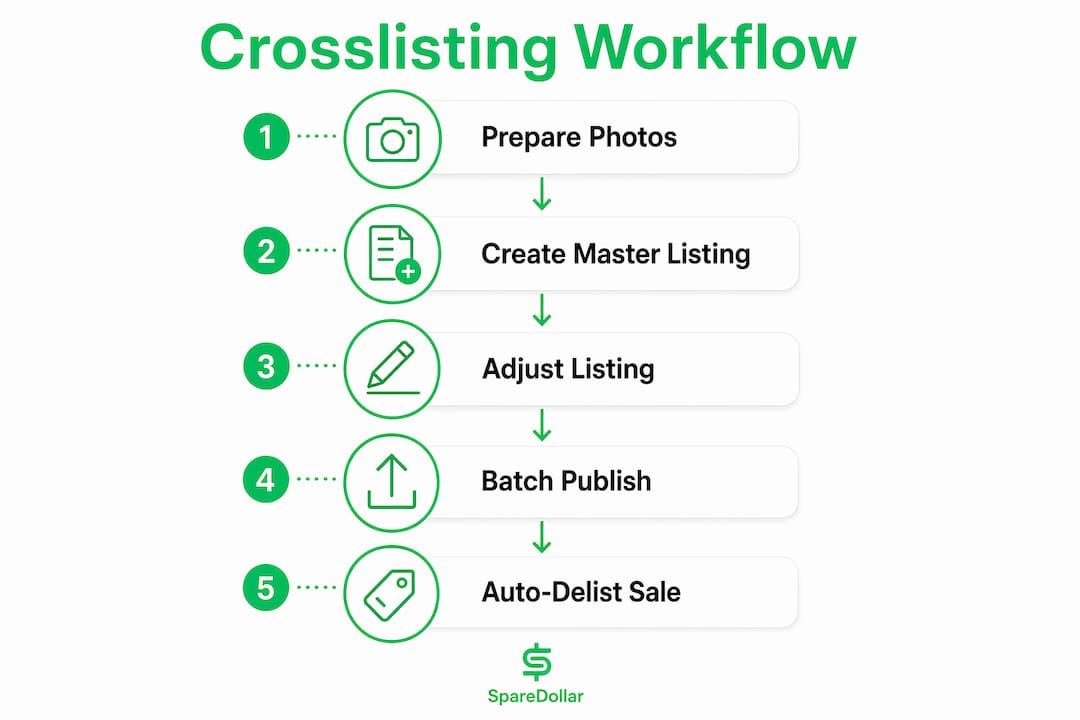
The full flow has six stages. Each one has a clear owner and a clear checkpoint.
- Build the master record on eBay: photos, SKU, brand, measurements, condition, cost, and storage location.
- Feed it to AI to generate platform-specific drafts — Poshmark style copy and eBay item specifics from the same input.
- Review and edit the Poshmark draft: brand-first title, short editorial description, size/fit callout, bundle language.
- Publish on Poshmark and schedule your sharing cadence (morning, afternoon, evening).
- Monitor for 24 hours post-publish: check both channels for sales and respond to offers.
- Auto-delist fires when a sale lands anywhere; confirm the delist, then update your inventory record.
The single most valuable automation in this chain is auto-delist on sale. Everything else saves time. Auto-delist prevents the double-sell disaster that costs you refunds, bad ratings, and seller standing.
Pro Tip: Set a realistic batch size of 10–20 items per session. Listing exhaustion from trying to push 50 items in one sitting is the fastest way to publish sloppy Poshmark listings that never convert.
How to build one master listing and turn it into a Poshmark post
The source-of-truth workflow starts with the most complete record possible, then adapts it — never the other way around.
- Capture the master record. Photo batch first: front, back, brand label, any flaws. Aim for 6–10 shots per item. Record SKU, brand, size, measurements, condition grade, cost, and storage bin.
- Run the AI draft. Feed the photo plus core metadata into your AI tool. Request two outputs: a Poshmark-style listing (brand-forward, editorial tone) and an eBay listing (structured item specifics, measurements first).
- Sanity-check the draft. Confirm brand recognition is correct, measurements match your notes, and the condition language is accurate. Fix anything the AI guessed wrong.
- Edit the Poshmark version. Brand name in position one of the title. Description under 200 words, editorial tone. Add one or two outfit-pairing lines. Include a clear size/fit callout. Strip all eBay return-policy boilerplate.
- Publish on Poshmark. Share immediately to followers and to any active Poshmark party that fits the category.
- Enable auto-delist. Confirm your inventory sync tool (SpareDollar handles this automatically) is watching both channels.
20-item batch checklist:
- Photos complete for all 20 items before opening any listing tool
- SKU, brand, measurements, and condition logged for each
- AI drafts generated in one batch run
- Each Poshmark draft reviewed for brand accuracy and fit language
- All 20 published with sharing cadence set
- Auto-delist confirmed active on every listing
Pro Tip: Batch your photos first, then batch your AI generation in one session. Batching only the publishing step saves maybe 20% of your time. Batching photos AND AI generation together cuts per-item time far more.
What exactly should you change from the eBay record for Poshmark?
Poshmark is social-fashion-first; eBay is search-and-specs-first. The same listing text that ranks well on eBay reads like a product manual on Poshmark. Understanding social commerce mechanics helps explain why Poshmark’s sharing and community features drive visibility in ways eBay’s search algorithm simply doesn’t.

| eBay field | Poshmark equivalent | What to change |
|---|---|---|
| Title (keyword-dense) | Title (50 chars, brand-first) | Move brand to position one; drop model numbers |
| Bullet-point item specifics | Short editorial description | Rewrite as 2–3 sentences, conversational tone |
| Measurements in inches | Fit notes (“runs small,” “fits a true M”) | Keep measurements AND add fit guidance |
| Return policy boilerplate | Remove entirely | Poshmark has its own return policy; don’t duplicate |
| No outfit context | 1–2 outfit pairing lines | Add: “Pairs well with straight-leg jeans and white sneakers” |
Operational Poshmark mechanics to build into your routine:
- Share your closet at least three times daily (morning, afternoon, evening). Poshmark’s feed is time-based, so a listing shared six hours ago is already buried.
- Send Offers to Likers within 24 hours of someone liking an item. This is one of the highest-conversion actions on the platform.
- Use bundle messaging in your description: “Buy 2+ items and save on shipping.”
Pro Tip: Three micro-edits that consistently lift Poshmark conversion: brand name first in the title, one outfit-pairing line in the description, and an explicit size-fit callout (“fits a true size 8, no stretch”). That’s it. Everything else is secondary.
What crosslisting mistakes will cost you the most?
Double-sells are the most expensive failure mode, and they’re entirely preventable. Here’s the short list of problems and their fixes:
- Double-sell: Auto-delist is the fix. If you’re listing manually, delist from every other platform within three minutes of confirming a sale — before you pack, before you print a label.
- Duplicate listings on one marketplace: One listing per item per marketplace, always. Duplicate listings violate platform terms and can get your account flagged.
- Pricing drift: Set a documented per-channel pricing rule. Poshmark takes 20% on items over $15; eBay averages around 13%. Price each listing to hit your target net margin after that platform’s fees, not a consistent sticker price.
- Photo/style mismatch: White-background photos work for eBay. Styled flat-lays or on-body shots convert better on Poshmark. Photograph both versions in the same session.
Before scaling to 100+ items, run a 10–20 item pilot. Confirm auto-delist fires correctly, pricing rules produce your target margin, and Poshmark descriptions are getting saves and likes within 48 hours.
Pro Tip: The simplest monitoring rule: check both platforms every time you get a sale notification, confirm the delist fired, and log it. That one habit prevents the vast majority of double-sell incidents for both solo sellers and small teams.
How much time and money does crosslisting actually cost?
Manual crosslisting takes 5–15 minutes per item per platform. For a 20-item batch going to two platforms, that’s 3–10 hours of pure listing work. AI-assisted drafting cuts that time sharply, though the exact savings depend on your workflow and review speed.
| Metric | Manual | AI-assisted |
|---|---|---|
| Time per item per platform | 5–15 min | Under 2 min (draft + review) |
| 20-item batch, 2 platforms | 3–10 hours | Under 1 hour |
| Double-sell risk | High (manual delist) | Low (auto-delist) |
| Per-channel pricing consistency | Manual, error-prone | Rule-based, documented |
Fees to factor into your margin math:
- Poshmark: $2.95 flat fee on items under $15; 20% on items $15 and above
- eBay: approximately 13% in combined fees
- A simple rule: set your list price so your net after fees hits your target, then adjust per platform
KPIs to track weekly:
- Sell-through rate per platform
- Days-to-sale (how long before an item moves)
- Double-sell incidents (target: zero)
- Margin per item after fees
- Time-per-listing (track improvement over four weeks)
How does SpareDollar solve the core crosslisting challenges?
SpareDollar is built around the single master record workflow. You import your eBay listings for free, and the AI generates platform-specific drafts for Poshmark, Depop, Mercari, and others from that one source record. The full feature set covers AI drafting, barcode scanning, bulk actions, per-channel pricing rules, inventory sync, auto-delist on sale, and sales analytics.
| Timeline | What to expect |
|---|---|
| Week 1 | eBay import complete; first AI drafts reviewed and published; auto-delist confirmed active |
| Week 2–4 | Per-channel pricing rules tuned; sharing cadence established; first sell-through data available |
| Month 3 | Measurable reduction in time-per-listing; double-sell incidents at or near zero; sell-through rate trending up |
Onboarding in five steps:
- Import your eBay listings into SpareDollar (free import, no manual re-entry).
- Generate AI drafts for your first 20-item Poshmark batch.
- Review each draft: confirm brand, measurements, and fit language.
- Publish to Poshmark via SpareDollar with auto-delist enabled.
- Monitor week-one KPIs and tune pricing rules based on early data.
Before starting a free trial, prepare a 20-item eBay batch with photos, SKUs, and condition notes ready. That gives SpareDollar enough to generate meaningful drafts and gives you a real test of the workflow.
Pre-launch checklist for your first Poshmark batch
Pre-listing:
- Photos complete (6–10 per item, including brand label and any flaws)
- Measurements, condition grade, SKU, and cost logged for each item
- Storage location noted
AI draft review:
- Brand identification confirmed correct
- Measurements match your notes
- Price suggestion reviewed against current Poshmark comps
Publish:
- Poshmark listing published with brand-first title
- Sharing cadence set (morning, afternoon, evening)
- Auto-delist sync confirmed active
Post-publish (first 24 hours):
- Check both platforms for sales
- Confirm auto-delist fires on first sale
- Update inventory record with live listing status
Key Takeaways
A repeatable AI-assisted workflow is the only way to crosslist eBay inventory to Poshmark at scale without double-sells or margin erosion.
| Point | Details |
|---|---|
| Start with a master record | Build the most complete listing first on eBay, then adapt it for Poshmark — never copy-paste. |
| Auto-delist is non-optional | Above 30 live listings, manual delist is too slow; auto-delist prevents double-sells and bad ratings. |
| Rewrite copy for Poshmark | Brand-first title, editorial description, and outfit-pairing lines outperform eBay-style specs on Poshmark. |
| Price per platform, not per item | Poshmark’s 20% fee and eBay’s ~13% require separate pricing rules to protect net margin. |
| SpareDollar automates the workflow | Free eBay import, AI drafts, per-channel pricing, and auto-delist in one tool built for eBay sellers. |
The case for mastering two marketplaces before adding a third
The sellers who scale fastest are almost never the ones who listed on six platforms in month one. They’re the ones who got eBay and Poshmark working cleanly first — auto-delist firing reliably, pricing rules documented, AI drafts consistently accurate — and then added a third channel when the system was stable.
Every marketplace you add multiplies your operational surface area. A pricing rule that works for two platforms needs to be re-examined for three. A delist protocol that’s reliable for two channels has more failure points at four. The compounding friction is real, and it shows up as double-sells, stale listings, and margin leaks you can’t trace back to a single cause.
The AI plus one source-of-truth model solves the core scaling problem: you’re not rewriting listings, you’re reviewing AI drafts. That’s a fundamentally different cognitive load. But the model only works cleanly when your sync and pricing rules are already tuned. Get eBay and Poshmark right first. Add Depop or Mercari when week-four KPIs show stable sell-through and zero double-sells. That’s the sequence that actually scales.
SpareDollar makes your first 20-item pilot surprisingly painless
Most eBay sellers spend their first week of crosslisting manually rewriting descriptions and frantically delisting sold items. SpareDollar skips that entirely. Import your eBay listings for free, generate Poshmark-ready AI drafts in one batch, review them, and publish with auto-delist already active. Your pilot plan: days 0–3, import and draft your first 20 items; days 4–7, publish and set your sharing cadence; days 8–14, review KPIs and tune pricing rules. No frantic tab-switching, no double-sell panic. Start your free trial at sparedollar.io and bring a 20-item eBay batch. (Why 20? Because that’s exactly enough to prove the workflow works — and not so many that you’ll regret it if you spelled “vintage” wrong. Dad joke fully intended.)
Useful sources
- Secnd: How to Cross List on Multiple Platforms — sell-through rate data and AI workflow benchmarks
- ShippingLabel: Cross-Listing on Mercari, Poshmark & Depop — double-sell prevention and auto-delist best practices
- Ecom AI Insights: Complete Guide for Resellers — platform selection, pricing rules, and compliance
- Resylr: How to Crosslist on Poshmark, eBay, and Depop — source-of-truth workflow and platform field mapping
- QuickList AI: The Reseller’s Crosslisting Guide — batch photography and AI generation workflow
- Poshmark seller help and fee documentation — current fee structure for pricing rule setup
- SpareDollar features overview — AI drafting, auto-delist, per-channel pricing, and analytics
FAQ
Does crosslisting to Poshmark violate eBay’s terms?
No. Crosslisting is permitted by all major marketplaces. The only rule is one listing per item per marketplace, and immediate delist when the item sells anywhere.
How long does it take to see results on Poshmark after crosslisting?
Most sellers see initial saves and likes within 48 hours of publishing. Consistent sales typically build over 4–6 weeks as your closet gains activity signals from sharing and offers.
What is Poshmark’s fee structure for crosslisted items?
Poshmark charges a flat $2.95 fee on sales under $15 and 20% on sales of $15 or more. Price each listing to hit your target net margin after that fee, not a consistent sticker price across platforms.
How do I prevent double-sells when crosslisting eBay items to Poshmark?
Enable auto-delist on sale through a tool like SpareDollar. If listing manually, delist from every other platform within three minutes of confirming a sale — before packing or printing a label.
Which items from my eBay inventory are best suited for Poshmark?
Branded fashion, accessories, and apparel convert best on Poshmark. Electronics, parts, and non-fashion categories rarely perform well there. Check that your items are priced at or above $15 to keep the 20% fee from wiping your margin.