Yes, you can resell on Shopify. The catch is that you have to sort out sales-tax registration and steer clear of counterfeit or trademark-infringing goods before you list a single item. Beyond that, Shopify is wide open to buy-resell, dropship, and used-goods sellers alike.
Your first moves matter more than your store theme:
- Get a resale certificate if your state requires one for sales-tax-exempt wholesale buying.
- Build unique-SKU listings for every one-of-a-kind item, with quantity set to 1.
- Put an inventory-sync plan in place before you crosslist to a second marketplace.
The tradeoff is simple: a Shopify store gives you the customer relationship and the margin. A marketplace gives you the foot traffic. You have to build the traffic yourself.
Key Takeaways
Reselling on Shopify works when sellers pair legal compliance with unique-SKU listings, reliable auto-delist workflows, and a breakeven-tested pricing model before scaling.
| Point | Details |
|---|---|
| Legal groundwork comes first | Get a resale certificate, check state sales-tax nexus rules, and skip LLC formation until you’re profitable. |
| Match your model to inventory | Buy-resell and dropship suit repeat stock; recommerce and consignment suit one-off vintage items. |
| Configure for unique inventory | Set quantity to 1, disable continue-selling settings, and grade condition honestly on every listing. |
| Prevent oversells with auto-delist | Fast webhook response and accurate SKU mapping matter more than any other crosslisting feature. |
| Run the breakeven math before scaling | Divide fixed costs by per-order fee savings to see how many orders justify a Shopify store. |
| Automate crosslisting once volume grows | SpareDollar lets eBay-first resellers draft one listing, publish across marketplaces including Shopify, and sync inventory automatically. |
Table of Contents
- How Do I Resell Legally on Shopify?
- Which Reselling Model Fits Your Inventory?
- How Do I Set Up Shopify for Resale Inventory?
- How Do You Prevent Double-Selling Across Channels?
- What’s the Breakeven Math for Shopify vs Marketplaces?
- Which Apps Actually Help You Resell Faster?
- What Fulfillment and Returns Setup Works for Resale?
- How Do You Market a Reseller Store on Shopify?
- Should You Try Reselling on Shopify Now?
- Ready to Stop Crosslisting by Hand?
- Sources
- FAQ
How Do I Resell Legally on Shopify?
Reselling legitimately acquired goods is protected under the first-sale doctrine. Once you buy something, you generally have the right to resell it, no permission needed from the original brand. Counterfeit goods are a different story entirely; selling fakes, even accidentally, can get your store shut down and expose you to legal liability.
Here’s the compliance sequence in order:
- Check your state’s resale certificate rules. Most states let registered resellers buy inventory tax-free from wholesalers, but you have to present a valid certificate to the supplier and check your state’s specific registration requirements before you assume you’re covered.
- Register for sales tax where you have nexus. If you’re shipping into a state where you have a physical presence, warehouse, or enough sales volume, you likely owe that state sales tax and need to register with its revenue department.
- Decide on a business entity later, not first. You don’t need an LLC to open a Shopify store, but you’ll want an EIN and a separate business bank account once money starts moving, mostly to keep your taxes sane come April.
Pro Tip: Call or email your state’s department of revenue directly instead of relying on a marketplace forum thread. Sales tax rules change more often than people update those threads.
Which Reselling Model Fits Your Inventory?
Not all reselling looks the same, and picking the wrong model for your inventory type is the fastest way to burn out in month two.
- Buy-resell: You purchase inventory upfront (liquidation pallets, wholesale lots, closeout deals), photograph it, and ship when it sells. Margins run higher, but you’re carrying the cash risk and the storage.
- Dropship: A supplier holds and ships the inventory; you never touch it. Lower margins, lower risk, and you’re at the mercy of someone else’s fulfillment speed.
- Recommerce (used/vintage): One-off items, thrifted finds, or trade-ins. Every unit needs its own photos and condition grade, which is slower per listing but often the highest margin per item, per Shopify’s recommerce guidance.
- Consignment: You list someone else’s inventory and split the sale. Zero upfront cost, but you’re managing someone else’s expectations along with your own.
If you’re moving one-off vintage pieces, recommerce fits. If you’re restocking the same SKU weekly, buy-resell or dropship makes more sense. Many sellers run marketplaces for volume and add Shopify once repeat buyers show up.
How Do I Set Up Shopify for Resale Inventory?
Generic store setup advice doesn’t work for resale. Used and one-of-a-kind items need their own configuration from day one.
- Build a SKU system that scales. Something like CATEGORY-DATE-NUMBER (e.g., DENIM-0126-014) keeps your inventory sortable once you pass 50 listings.
- Set quantity to 1 and disable “continue selling when out of stock.” Shopify’s own reseller workflow guidance flags this as the single most common setup mistake for unique-item sellers. Skip it, and you’ll sell the same vintage jacket twice.
- Grade condition honestly. Use a consistent scale (new, excellent, good, fair) on every listing, and photograph flaws, not just the flattering angles.
- Configure Shopify Payments, tax settings, and shipping profiles before your first sale, not after your first refund request.
- Write an About page and a plain-English returns policy. Buyers of used goods want to know who they’re dealing with and what happens if the item doesn’t match the photos.
Pro Tip: Photograph every item against the same background and in the same lighting. It looks more professional, and it cuts your editing time in half once you’re listing dozens of items a week.
How Do You Prevent Double-Selling Across Channels?
Selling the same one-of-a-kind item on two marketplaces at once is the single fastest way to torch your seller rating. Auto-delist reliability matters more than almost any other feature you’ll evaluate, since a delay of even a few minutes on a popular item can mean an oversold order and an unhappy customer.
- If you’re listing fewer than 20 items a week, a manual crosslisting checklist (list, sell, delist within the hour) is honestly fine.
- Past that volume, you need automated crosslisting tools with fast webhook response times and accurate SKU mapping between platforms.
- When a double-sell happens anyway, refund the second buyer immediately, apologize, and offer a discount on a future purchase. Silence makes it worse.
- While you’re testing a new integration, keep a small inventory buffer or short hold time on high-demand items so a lag doesn’t cost you a sale.
Pro Tip: Run any new crosslisting tool on your slowest-moving items first. If something breaks, you want it to break on the $12 mug, not the $400 jacket.
What’s the Breakeven Math for Shopify vs Marketplaces?
The formula is straightforward: monthly fixed costs ÷ per-order fee savings versus your marketplace = orders needed to break even, a rule that shows up consistently in reseller breakeven guides. Your per-order cost side needs to include cost of goods, shipping, a returns reserve, app subscriptions, and any ad spend, not just the Shopify plan fee.
Here’s how that plays out at different average order values:
- $35 AOV: Thin margins mean you need higher volume to clear fixed costs; Shopify tends to make sense only once you have a repeat-buyer base.
- $50 AOV: The math starts favoring Shopify once you’re saving meaningfully on marketplace fees per sale.
- $100 AOV: Fewer orders are needed to break even, so Shopify often pays for itself fast on higher-ticket resale items like furniture or designer pieces.
The decision rule: test Shopify when you have repeat buyers, some owned traffic (email, social following), and a reasonably predictable AOV. Without those three, a marketplace-only approach usually stays cheaper.
Which Apps Actually Help You Resell Faster?
Five app categories cover most of what a reseller actually needs:
- Cross-listing and auto-delist tools
- Quick mobile listing apps (photo-to-listing in minutes)
- Inventory sync across marketplaces
- Repricers for competitive-priced categories
- Fulfillment connectors for label printing and tracking
When you evaluate any of these, check delist speed first, SKU mapping accuracy second, and support responsiveness third. A tool that syncs inventory slowly is worse than no tool at all, because it gives you false confidence.
Listing speed and consistent item specifics drive conversion for used goods. The better the photos and condition grading, the higher the conversion rate from paid traffic, according to Shopify’s own reseller guidance.
SpareDollar was built around exactly this problem for eBay-first resellers moving into multi-marketplace selling. You draft one AI-assisted listing, publish it across marketplaces including Shopify, and let inventory sync handle the auto-delist part so you’re not refreshing five tabs at midnight.
Pro Tip: Measure ROI on any listing tool by tracking hours saved per week, not just dollars. If a tool buys you back five hours, that’s five hours you can spend sourcing more inventory.
What Fulfillment and Returns Setup Works for Resale?
Self-fulfillment works fine for most resellers starting out. Package carefully, insure anything over $75 in value, and always use tracked shipping. Used goods get damaged in transit more often than new items packed in factory boxes, so a little extra bubble wrap pays for itself.
- Consider a 3PL or Shopify Fulfillment Network once you’re shipping more than a few dozen orders a week and packing is eating your evenings.
- Write a returns policy specific to one-of-a-kind items. Since you can’t restock an identical replacement, spell out whether buyers get a refund, store credit, or exchange.
- Include a condition disclaimer on every used listing so a returns dispute doesn’t come down to he-said-she-said.
- Reduce shipping losses with a free-shipping threshold above your average order value, and negotiate carrier discounts once volume justifies it.
How Do You Market a Reseller Store on Shopify?
Marketplaces are still your best discovery engine early on. Once you’ve got repeat buyers, funnel them toward your own store where you keep more margin.
- Lean on marketplace search traffic for new customer discovery, then use packaging inserts and post-purchase emails to introduce your Shopify store.
- Post short video content with product tags and a link in bio. Instagram stickers on Stories work well for one-off vintage drops.
- Capture email at checkout and set a free-shipping threshold to boost average order value.
- Track ROAS by channel monthly, and shift ad budget toward whichever platform is actually converting, not just generating clicks.
Should You Try Reselling on Shopify Now?
If you’ve got repeat buyers, decent margins, and some owned traffic, test Shopify. If you don’t have any of those three yet, stay on marketplaces a little longer.
30-day checklist: resale certificate sorted, 10 to 20 product pages live, shipping and tax settings configured, a basic delist SOP written down.
90-day goals: trial a crosslisting tool like SpareDollar, grow your email list past double digits, and run one real marketing test. Track repeat-purchase rate and email signups to decide whether scaling makes sense.
A Reseller’s Notes From the Trenches
Build three habits early: a photo checklist, a condition-grading template, and a daily delist check before bed. Most new resellers overbuy tools before they’ve got the volume to justify them, so start manual and automate later. And yes, SpareDollar is capitalized with a capital S and a capital D, kind of like how your bank account capitalizes every time a resale actually clears.

Ready to Stop Crosslisting by Hand?
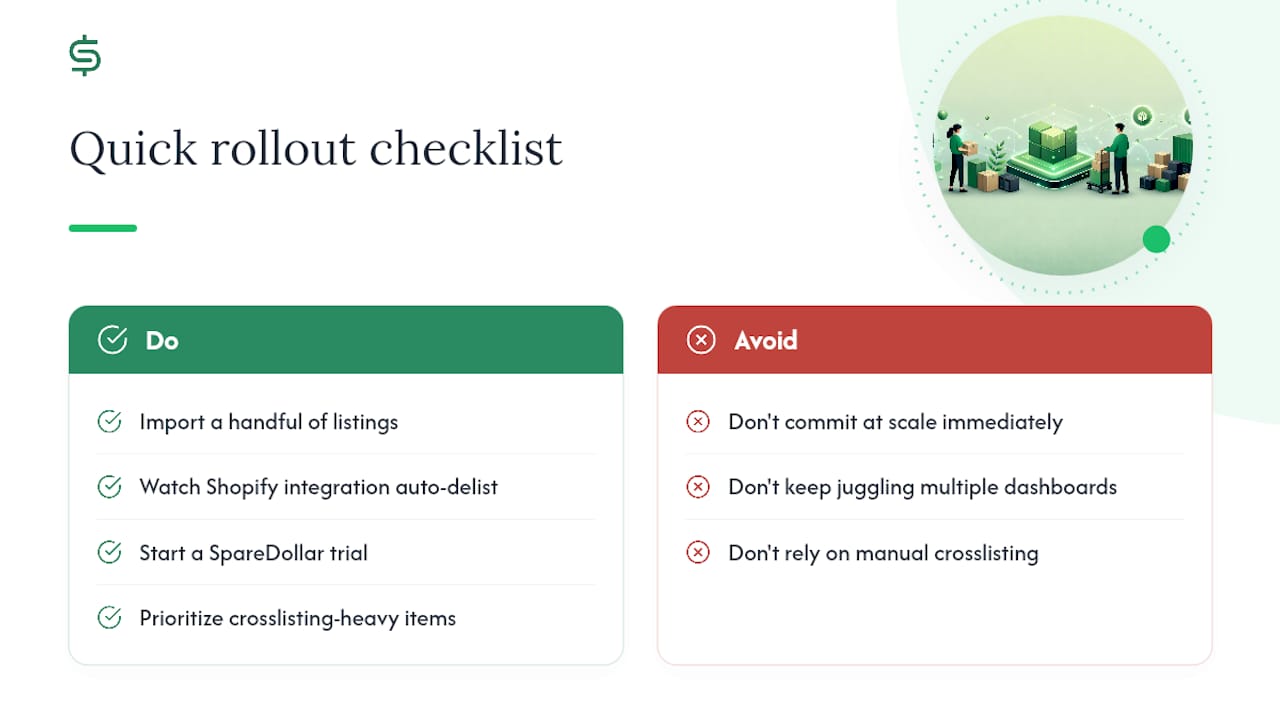
If you’ve been juggling tabs across eBay, Poshmark, and Shopify trying to keep inventory straight, you already know the real cost isn’t the marketplace fees, it’s the hours lost to manual crosslisting and the oversells that slip through anyway. SpareDollar was built for exactly this: eBay-first resellers who need one listing to publish everywhere, with inventory sync and auto-delist doing the boring work so you don’t have to babysit five dashboards.
A good first step is importing a handful of your current listings and watching how the Shopify integration handles auto-delist in real time before you commit anything at scale. If you’re mostly crosslisting-heavy right now, that’s exactly who this fits. Start a trial at SpareDollar and see how many hours you get back this week.
Sources
Check Shopify’s reseller guide, its selling how-to, reseller program terms, and SpareDollar’s trial page.
- Wholesale products for resale - Shopify blog
FAQ
Is Shopify Good for Reselling?
Yes. Shopify supports inventory sync, multiple sales channels, and Shop Pay checkout, all of which help resellers manage unique or repeat-stock inventory once they’ve built some owned traffic.
How Much Does Shopify Take From a $100 Sale?
Shopify’s cut depends on your plan and payment processor rather than a flat marketplace-style fee, so the exact deduction varies by your specific plan tier and transaction settings.
Is Reselling Allowed on Shopify?
Yes, reselling legitimately acquired goods is allowed under the first-sale doctrine. Counterfeit or trademark-infringing items are not, and Shopify can suspend stores that list them.
Do I Need an LLC to Sell on Shopify?
No. You don’t need an LLC to open a Shopify store, but you’ll likely need a resale certificate and should check your state’s registration requirements before your first wholesale purchase.