
Yes, you can make real money reselling on Facebook Marketplace, and the fastest path is local-first flips: buy items nearby, skip shipping, and sell them for pickup so you keep 100% of the sale price. Facebook charges no platform fee on local pickup transactions, while shipped orders get a seller fee deducted at checkout. Practitioner data suggests local bulky items frequently sell for 40 to 70% below retail, which is exactly the gap flippers profit from.
Here’s the immediate playbook:
- Chase furniture, bikes, tools, and exercise equipment first. They’re heavy, buyers rarely negotiate shipping, and owners underprice them constantly.
- Run every listing through sold comps before you buy anything.
- Use the 60-second flip rule: if you can’t decide in a minute whether it’s profitable, pass.
- Write listings with real photos, real measurements, and a fair price with a little room to negotiate.
Quick math: a $200 dresser bought for $60 nets you $140 on local pickup. Ship that same dresser and freight costs alone could eat your entire margin.
Key Takeaways
Profiting on Facebook Marketplace comes down to local-first flips with zero platform fees, fast sourcing decisions, and listings that convert on the first look.
| Point | Details |
|---|---|
| Prioritize local pickup | Local pickup carries no platform fee, keeping your full sale price intact. |
| Use the 60-second flip rule | Check sold comps, condition, and effort in under a minute before buying anything. |
| Price with negotiation room | Build in 10 to 15% buffer since most buyers open with a lower offer. |
| Track every deal’s real margin | Log acquisition cost, fees, and net profit to know which categories actually work. |
| Sync inventory before scaling | Tools like SpareDollar sync stock across marketplaces so a sale in one place auto-delists elsewhere. |
Table of Contents
- Best Categories to Resell for the Highest Profit
- Where Do You Find Inventory Fast?
- How Do Marketplace Fees Affect Your Pricing?
- What Makes a Listing Sell Fast?
- How Do You Avoid Scams and Meet Buyers Safely?
- Which Tools Speed Up Scaling Your Reselling?
- When Does Shipping Actually Make Sense?
- How Do You Negotiate and Close Sales Fast?
- How Do You Scale Beyond a Few Listings a Week?
- Local Pickup or Shipping: How Do You Decide?
- What I’ve Learned Watching Resellers Scale
- How SpareDollar Helps You List Faster and Sell Everywhere
- Where to Verify Fees and Policies
- Sources
- FAQ
Best Categories to Resell for the Highest Profit
Furniture, bikes, exercise equipment, tools, select electronics, and collectibles consistently return the best margins on Facebook Marketplace. These categories share a structural advantage: they’re heavy or bulky enough that shipping rarely makes sense, buyers inspect them in person instead of demanding return policies, and sellers routinely underprice because they just want the stuff gone.

A treadmill listed for “$50, needs to go this weekend” is a different animal than one priced by someone who researched resale values. Estate sales and divorces produce the same effect on dining sets and power tools.
To find your niche fast, pick two or three categories you can identify condition and value on quickly, then run five to ten sold comps before your first purchase. If comps show consistent 30% or higher spread, you’ve got a lane worth working.
Pro Tip: Collectibles look tempting but require the most expertise. Stick to furniture and tools until you’ve built a feel for pricing, then branch out.
Where Do You Find Inventory Fast?
Speed beats patience here. The best deals get snapped up within minutes of posting, so your sourcing routine needs structure, not luck.
- Set saved searches with a tight radius and a price ceiling, and turn on alerts so new listings hit your phone immediately.
- Scroll your local buy/sell groups daily, especially early morning and Sunday evening when weekend movers post.
- Hit thrift stores and clearance aisles on markdown days, and treat garage or estate sale listings as a live feed of underpriced furniture.
- Apply the 60-second flip framework: check sold comps, eyeball condition from the photos, estimate pickup effort, and decide. If any of those three raise doubt, pass and move on.
Pro Tip: Keyword alerts for misspellings (“dresser” typed as “draser”) catch listings other flippers’ searches miss entirely.
How Do Marketplace Fees Affect Your Pricing?
Local pickup sales carry no platform fee, so a $150 sale means $150 in your pocket minus what you paid. Shipped Marketplace orders deduct a seller fee at checkout, and the exact rate is worth double-checking in your seller settings since Meta adjusts these terms.
Your profit formula stays simple: sale price minus acquisition cost minus fees minus prep time = actual profit. A $40 end table you bought for $10 and sold locally nets $30. Ship a $40 item and the seller fee plus your own packaging materials can quietly wipe out half that margin, especially on anything under $50.
- Price with 10 to 15% negotiation room built in, since almost every buyer opens with a lower offer.
- Set a floor price before you list, so a lowball offer doesn’t catch you improvising a “yes” you’ll regret.
- Reserve shipping for lightweight, high-margin items where the math still works after fees.
Quick gut check: if your net-after-fee profit on a shipped item drops below $15 to $20, local pickup or a different item is almost always the better call.
What Makes a Listing Sell Fast?
Photos and titles do most of the heavy lifting before a buyer ever messages you. Sloppy listings sit for weeks; sharp ones sell in days.
- Shoot 5 to 10 photos: wide shots, close-ups of any damage, brand tags, and something showing scale (a tape measure or a person standing nearby).
- Write titles as brand or model, plus condition, plus the one feature buyers search for: “IKEA Malm Dresser, 6-Drawer, Good Condition, White.”
- Fill the description with exact measurements, material, age if known, and honest flaws. Clear, detailed descriptions cut down on wasted back-and-forth messages and get you to a sale faster.
- Post in relevant local buy/sell groups in addition to Marketplace itself, and use the “list in more places” option Facebook offers during listing creation.
Renew or refresh your listing every 7 days if it hasn’t sold. A small price cut or title tweak resets visibility in the feed without you starting over.
- Skip stock photos entirely. Buyers assume a scam the moment they see a catalog image on a used couch.
- Respond to the first message within an hour when you can. Slow replies lose deals to faster sellers, full stop.
How Do You Avoid Scams and Meet Buyers Safely?
Most Marketplace scams follow a pattern: someone offers to overpay and asks you to refund the difference, or pushes hard to move the conversation off Facebook before you’ve even agreed on a price. Both are red flags worth walking away from.
- Meet in public, well-lit locations, or use a police-designated safe exchange zone if your city offers one.
- Confirm payment has actually cleared before handing over the item, especially with Venmo or Zelle, where “pending” isn’t the same as “paid.”
- Watch for brand-new profiles with no photo, no friends, and an urgent story about why they can’t meet in person.
- Cash works fine for lower-value items; digital payments are easier to trace but not instant-proof against reversal scams.
A short closing script keeps things moving: “Still available, can you do [time] at [location]?” It filters out tire-kickers fast and gets serious buyers to commit. This lines up with the safety guidance most consumer finance sites recommend.
Pro Tip: If a buyer insists on shipping payment for a local pickup item “for convenience,” that’s not convenience, that’s a scam script. Say no and move on.
Which Tools Speed Up Scaling Your Reselling?
Speed wins deals, but speed without inventory control creates its own mess. The moment you list the same item on two platforms without syncing stock, you risk selling something twice and disappointing a buyer who already paid. Automated sourcing and cross-listing workflows now materially outperform manual monitoring for hit rate, but only when the back end keeps up.
- Cross-list the same item across Marketplace, eBay, and Poshmark, but only when your inventory sync actually pulls the listing everywhere the second it sells.
- Avoid cross-listing collectibles or one-of-a-kind items manually if you can’t check every platform daily. One oversell erases the profit on three good flips.
- Batch your photo and description work in one sitting rather than listing item by item.
This is where a tool like SpareDollar earns its keep. It drafts listings with AI, keeps item specifics consistent, and syncs inventory across marketplaces so a sale on one channel auto-delists everywhere else. Think of it as the seatbelt for your side hustle: you hope you never need it, right up until you really do.
Pro Tip: Set aside one hour a week just for cleaning up cross-listed inventory. It’s the cheapest insurance against a canceled sale and an angry buyer.
When Does Shipping Actually Make Sense?
Ship only when the net-after-fee math still clears $15 to $20 in profit, and only for items light enough that packaging and postage don’t eat the margin. Sold comps tell you the ceiling; your fee and shipping cost tell you whether it’s worth the box.
- Weigh and measure every item before listing a shipped price, not after a buyer commits.
- Use appropriately sized boxes and real cushioning. A cracked item on arrival means a refund and a bad review.
- If you ship often, a thermal label printer pays for itself within a couple months in time saved.
- Ship inside your stated window, upload tracking immediately, and photograph the item’s condition before it leaves your hands. That photo is your proof if a buyer claims damage.
How Do You Negotiate and Close Sales Fast?
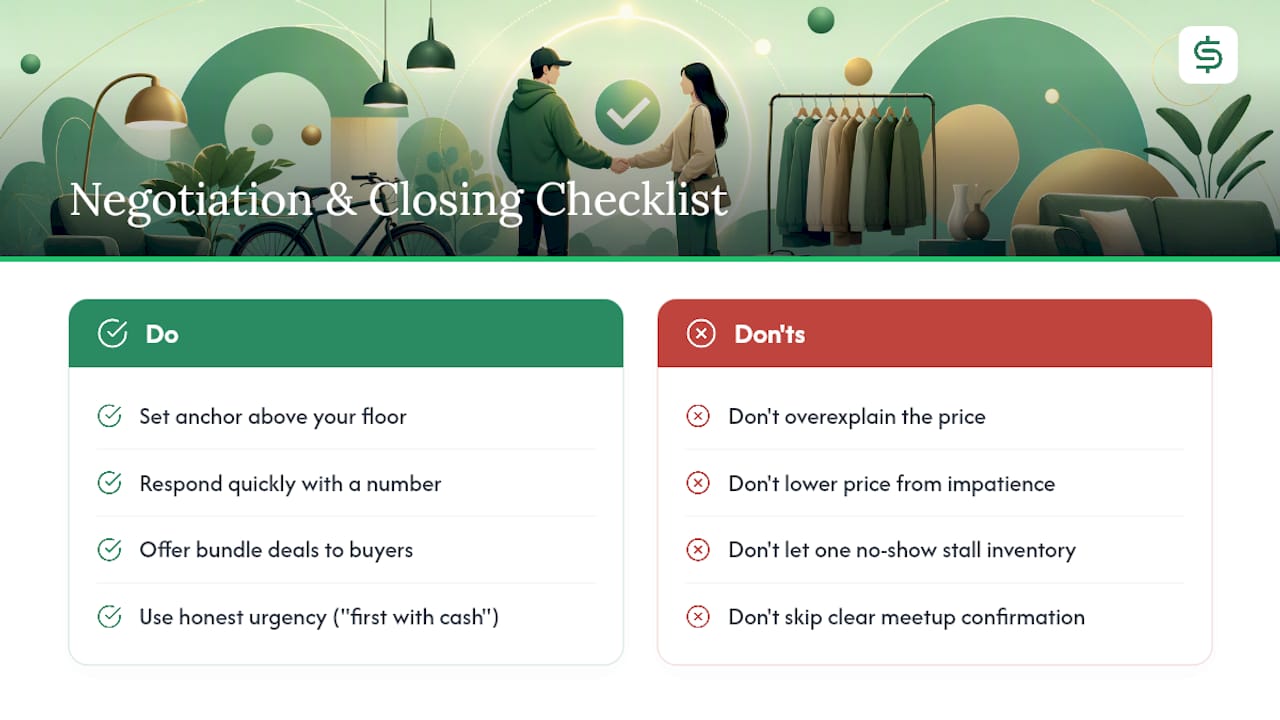
Every Marketplace negotiation follows a rhythm: price anchor, counteroffer, and close. Buyers open low almost by reflex, so build that room into your listing price from the start instead of getting defensive when the lowball message hits.
Respond fast and respond with a number, not a paragraph. “I can do $80, firm at $75” moves things forward faster than a lecture about the item’s original retail price. Buyers ghost sellers who overexplain.
Bundle deals close more sales than single-item haggling. If someone’s eyeing a dresser, mention you’ve also got a matching nightstand for $20 more. It raises your total sale value and gives the buyer a reason to commit today instead of thinking it over.
Set a real floor before you post the listing, and stick to it. Sellers who cave on price out of impatience train buyers to lowball every future listing they see from that same profile.
Urgency works both directions. “I’ve got another buyer coming to look at 5pm” is honest leverage if it’s true, and it often is, since good deals attract multiple messages within the hour. Use it plainly, without games: “First one here with cash gets it.”
For no-shows, give a 10 to 15 minute grace window, then move to the next interested buyer on your list. Never let one flaky buyer hold your inventory hostage for a day.
Close with a clear, simple confirmation: time, place, price, and payment method, all agreed before anyone leaves the house. Ambiguity is where deals fall apart at the meetup, not before it.
How Do You Scale Beyond a Few Listings a Week?
Scaling starts with tracking, not more hustle. A simple spreadsheet logging acquisition price, prep cost, fees, sale date, and net profit turns guesswork into a repeatable system, and it tells you within a week which categories are actually worth your time.
Once you’re consistently moving five or more items a week, the bottleneck shifts from sourcing to listing speed. Batch photography sessions, pre-written description templates for repeat categories (dressers, treadmills, patio sets), and a fixed pickup schedule all cut the hours you spend per item.
Outsourcing makes sense earlier than most people think. A teenager or part-time helper can handle pickups and photo staging for a flat fee per item, freeing you to focus on sourcing and pricing decisions, the parts that actually require judgment.
Cross-listing multiplies your reach, but only survives contact with reality if your inventory stays synced. Selling the same couch on Marketplace and Facebook groups without a system tracking which platform sold it first is how you end up apologizing to two buyers instead of thanking one. That’s the exact problem inventory sync tools solve once volume passes what you can track manually in your head.
The sellers who scale past a side hustle into real income treat this like a small business from week one: they know their margin per category, their average time-to-sale, and which sourcing channel actually produces.
Local Pickup or Shipping: How Do You Decide?
Default to local pickup unless the math clearly favors shipping. Heavy, bulky, or low-value items almost always lose money the moment you add a box and postage on top of a platform fee.
Run this quick test before you decide: check your sold comps for both local and shipped versions of the item, subtract the seller fee on shipped orders, then subtract packaging and your own drive-time cost for local pickup. Whichever number is higher wins, every time.
Small, durable, high-demand items (collectible toys, certain electronics, sealed cosmetics) tend to ship well because their value-to-weight ratio holds up. A vintage lunchbox worth $60 ships easily. A $60 bookshelf does not.
Geography matters too. If your local market is saturated with a category (say, everyone’s selling the same brand of treadmill after New Year’s resolutions fade), shipping opens up buyers outside your immediate area who’ll pay closer to full comp value. That’s the one scenario where shipping can actually beat local pickup on net profit, even after fees.
When in doubt, list local pickup first. You can always switch to shipping eligibility later if the item sits without an offer.
What I’ve Learned Watching Resellers Scale
The resellers who actually build steady income treat Marketplace like inventory management first, hustle second. The ones who stall out are almost always great at sourcing and terrible at tracking what they already have listed.
Inventory sync isn’t a nice extra once you’re cross-listing. It’s the difference between a business and a chaotic group chat with yourself. And yes, SpareDollar helps with that. Consider it the “measure twice, cut once” of reselling, minus the sawdust.
How SpareDollar Helps You List Faster and Sell Everywhere
If you’re already juggling Marketplace, eBay, and maybe Poshmark or Depop, the real cost isn’t sourcing, it’s the hours lost rewriting the same listing three times and the stress of wondering if you just oversold something. SpareDollar fixes both: draft a listing once with AI-assisted item specifics, push it to multiple marketplaces, and let inventory sync auto-delist everywhere else the moment something sells.
It’s built for sellers who cross-list often or just want their evenings back instead of spending them retyping descriptions. Bulk actions and per-channel pricing mean you’re not stuck manually adjusting ten listings every time you want to test a new price point.
If listing time is eating into your margin, take a look at SpareDollar’s marketplace integrations and see how it fits your current workflow.
Where to Verify Fees and Policies
- Check current fee terms directly in your Facebook Marketplace seller settings, since rates and shipping rules change.
- Review sourcing tactics and category data in the Marketplace flipping guide.
- Confirm platform reach using Statista’s Facebook user data.
Sources
- How to Sell on Facebook Marketplace - NerdWallet
- Facebook Marketplace Flipping Guide: Best Items 2026
- Number of monthly active Facebook users worldwide
- How to Make Money Flipping on Facebook Marketplace (2026) | SuperFlip AI
FAQ
Can you make good money reselling on Facebook Marketplace?
Yes, especially with local-first flips on bulky items like furniture and exercise equipment, where you avoid platform fees entirely and items often sell 40 to 70% below retail, leaving room for solid margins.
Is reselling allowed on Facebook Marketplace?
Yes, reselling is permitted as long as listings follow Meta’s commerce policies and you’re honest about condition and ownership; check current terms in your seller settings for specifics.
What is the best thing to resell on Facebook Marketplace?
Furniture, bikes, exercise equipment, and tools consistently return the highest margins because they’re heavy enough to discourage shipping and frequently underpriced by sellers who just want them gone.
How much is the fee to sell on Facebook Marketplace?
Local pickup transactions have no platform selling fee, while shipped orders through Marketplace checkout have a seller fee deducted, so it’s worth verifying the current rate in your seller settings before pricing a shipped listing.